Monday, June 11, 2018

Dangerous people are teaching our kids - Jordan Peterson

You may not realize it, but you are currently funding some dangerous people.

They are indoctrinating young minds throughout the West with their resentment-ridden ideology. They have made it their life's mission to undermine Western civilization itself, which they regard as corrupt, oppressive and “patriarchal.”

If you're a taxpayer—or paying for your kid's liberal arts degree—you're underwriting this gang of nihilists.

You're supporting ideologues who claim that all truth is subjective; that all sex differences are socially constructed; and that Western imperialism is the sole source of all Third World problems. They are the post-modernists, pushing “progressive” activism at a college near you.

They produce the mobs that violently shut down campus speakers; the language police who enshrine into law use of fabricated gender pronouns; and the deans whose livelihoods depend on madly rooting out discrimination where little or none exists.

Their thinking took hold in Western universities in the ‘60s and ‘70s, when the true believers of the radical left became the professors of today. And now we rack up education-related debt—not so that our children learn to think critically, write clearly, or speak properly, but so they can model their mentors' destructive agenda.

It's now possible to complete an English degree and never encounter Shakespeare—one of those dead white males whose works underlie our “society of oppression.”

To understand and oppose the post-modernists, the ideas by which they orient themselves must be clearly identified.

First is their new unholy trinity of diversity, equity and inclusion. Diversity is defined not by opinion, but by race, ethnicity or sexual identity; equity is no longer the laudable goal of equality of opportunity, but the insistence on equality of outcome; and inclusion is the use of identity-based quotas to attain this misconceived state of equity.

All the classic rights of the West are to be considered secondary to these new values. Take, for example, freedom of speech—the very pillar of democracy. The post-modernists refuse to believe that people of good will can exchange ideas and reach consensus.

Their world is instead a Hobbesian nightmare of identity groups warring for power. They don't see ideas that run contrary to their ideology as simply incorrect. They see them as integral to the oppressive system they wish to supplant, and consider it a moral obligation to stifle and constrain their expression.

Second is rejection of the free market—of the very idea that free, voluntary trading benefits everyone. They won't acknowledge that capitalism has lifted up hundreds of millions of people so they can for the first time in history afford food, shelter, clothing, transportation—even entertainment and travel. Those classified as poor in the US (and, increasingly, everywhere else) are able to meet their basic needs. Meanwhile, in once-prosperous Venezuela—until recently the poster-child of the campus radicals—the middle class lines up for toilet paper.

Third, and finally, are the politics of identity. Post-modernists don't believe in individuals. You're an exemplar of your race, sex, or sexual preference. You're also either a victim or an oppressor. No wrong can be done by anyone in the former group, and no good by the latter. Such ideas of victimization do nothing but justify the use of power and engender intergroup conflict.
All these concepts originated with Karl Marx, the 19th-century German philosopher. Marx viewed the world as a gigantic class struggle—the bourgeoisie against the proletariat; the grasping rich against the desperate poor. But wherever his ideas were put into practice—in the Soviet Union, China, Vietnam, and Cambodia, to name just a few—whole economies failed, and tens of millions were killed. We fought a decades-long cold war to stop the spread of those murderous notions. But they're back, in the new guise of identity politics.

The corrupt ideas of the post-modern neo-Marxists should be consigned to the dustbin of history. Instead, we underwrite their continuance in the very institutions where the central ideas of the West should be transmitted across the generations. Unless we stop, post-modernism will do to America and the entire Western world what it's already done to its universities.

I'm Jordan Peterson, Professor of Psychology at the University of Toronto, for Prager University.

Tuesday, March 20, 2018

The Psychology of Progressive Hostility

The Psychology of Progressive Hostility

Recently, I arrived at a moment of introspection about a curious aspect of my own behavior. When I disagree with a conservative friend or colleague on some political issue, I have no fear of speaking my mind. I talk, they listen, they respond, I talk some more, and at the end of it we get along just as we always have. But I’ve discovered that when a progressive friend says something with which I disagree or that I know to be incorrect, I’m hesitant to point it out. This hesitancy is a consequence of the different treatment one tends to receive from those on the Right and Left when expressing a difference of opinion. I am not, as it turns out, the only one who has noticed this.
“That’s a stupid fucking question,” answered a Socialist Alliance activist when I asked sincerely where they were getting what sounded like inflated poverty statistics. “If you don’t believe in gay marriage or gun control, unfriend me,” demand multiple Facebook statuses from those I know. “That’s gross and racist!” spluttered a red-faced Ben Affleck when the atheist and neuroscientist Sam Harris criticized Islamic doctrines on Bill Maher’s Real Time. Nobody blinks an eye when Harris criticizes Christianity, least of all Affleck, who starred in Kevin Smith’s irreverent religious satire Dogma. But Christians are not held to be a sacrosanct and protected minority on the political Left. As Skeptic Magazine’s Michael Shermer tweeted recently:
Outbursts of emotional hostility from progressive activists – now described as Social Justice Warriors or SJWs – have come to be known as getting ‘triggered.’ This term originally applied to sufferers of Post-Traumatic Stress Disorder, but activists have adopted it to describe the anxiety and discomfort they experience when they are exposed to views with which they disagree. “Fuck free speech!” one group of social justice advocates recently told Vice Media, as if this justified the growing belief among university students that conservatives should be prevented from speaking on college campuses. It’s no secret that, with the rise of the triggered progressive, university professors are increasingly intimidated by their own students. An illustrative example of this alarming trend was provided by the hoards of screaming students who surrounded the distinguished Yale sociologist Nicholas Christakis and demanded his head (which they duly received). Christakis had made the mistake of defending an email his wife had written gently criticizing Yale’s attempts to regulate students’ Halloween costumes. “Who the fuck hired you?!” screamed one irate student in response. “You should step down!”

This sort of my-way-or-the-highway mentality is now spreading well beyond the urban university and into even remote communities. In the small Outback Australian town of Alice Springs where I once lived, agitators have attacked and attempted to silence the local aboriginal town councillor Jacinta Price for her principled efforts to improve the lives of her people. When Price tried to sound the alarm about skyrocketing sexually transmitted diseases, or the adult rape of children in aboriginal communities, she was shouted down as a ‘traitor’ and a ‘coconut’ (a term of disparagement used to describe a person deemed to be black on the outside and white on the inside). These criticisms do not come from the majority of aboriginal people in Alice Springs, but from a minority of furiously offended activists who, in their own little circles, plot to have Price undemocratically removed from the town council. Censorship is now the instrument of choice, and a reactionary authoritarianism increasingly defines what the liberal Muslim activist Maajid Nawaz has termed the ‘Regressive Left.’
So how and why have these activists become so intolerant and horrible to deal with? Part of this hostility can be explained by a wilful ignorance and incuriosity about ideas with which they disagree.

Every so often, a progressive friend will peruse my bookshelf in a thought-police sort of fashion. What happens next is fairly predictable. Once they realize that Malinowski’s Melanesian epic The Sexual Life of Savages doesn’t include any erotic pictures, they will turn their attention to the Ayn Rand collection. “Why do you have these?” they ask with an air of indignation, holding up a copy of Capitalism: The Unknown Ideal. “Have you ever read her?” I will ask. “No,” they reliably respond.
The liberal philosopher John Stuart Mill once explained that, “The greatest orator, save one, of antiquity, has left it on record that he always studied his adversary’s case with as great, if not with still greater, intensity than even his own.” Mill held that unless we carefully study the views of those with whom we disagree, we will never really know what they’re right or wrong about. “He who knows only his own side of the case,” Mill wrote in his 1859 book On Liberty, “knows little of that.” Our opponents could be right for all we know or care, because they may know a fact or offer an argument we’ve never thought to consider. And even if they aren’t right, Mill points out that specks of truth may exist among their falsehoods which can guide our minds in new directions.

Sprinkled throughout what I regard as Rand’s erroneous theory of Objectivism, are moments of penetrating insight. In his critique of her work, the late president of the American Philosophical Society Robert Nozick called her writing “powerful, illuminating and thought provoking.”1
The world is more complex than we can imagine, and every new point of view we encounter can enrich our understanding even if we don’t embrace it entirely. But this comes with the risk of self-effacement and growing uncertainty. Imagine that you are standing in a small clearing in the middle of a vast forest, and that this forest represents your ignorance of the world. The clearing you stand in represents your knowledge. As one gains knowledge, the clearing expands and the forest of ignorance recedes. But as the clearing expands, so does its circumference and so the area of contact between knowledge and ignorance also grows, and our knowledge of the extent of our ignorance grows with it. So, paradoxically, the wiser we become, the less wise we feel. This is the wellspring of intellectual humility, the Socratic realization that the more you know, the more you realize you don’t know, and the more apparent it becomes that your own opinions are susceptible to fallibility.

This is a tremendous problem for progressive students entering higher education, where remarkably homogenous viewpoints are taught and heterogeneous ideas are shunned. For example, one of the concepts most ridiculed by philosophers in recent decades has been the notion of ‘social justice,’ which has received such a beating that the Nobel Prize winning economist and philosopher Friedrich von Hayek once remarked that shame should fall upon people who still defend the idea.2 But ask any self-described social justice advocate to name a critic of the very idea of social justice, and they will likely draw a blank. Criticisms of social justice are routinely swept under the carpet in an environment where students are asked to embrace the concept hand-on-heart, as if no reasonable or legitimate objections had ever existed.

A whole raft of brilliant philosophers and Nobel Prize-winning economists lean to the right. The problem is that these people tend to go into business or enter academic fields like engineering, economics, and mathematics. They have therefore surrendered the humanities and what philosopher Roger Scruton has called the ‘fake fields’ of gender and ethnic studies to their political opponents on the Left, who relish their role as the unchallenged shapers of student minds. According to a 2005 survey3 conducted in the United States, there was only one Republican sociology professor in the humanities for every 40 Democrat professors, and we now know the extent of the resentment when views outside the progressive consensus trespass on their territory.

Last year, the Wilfred Laurier scandal shocked conservative and moderate professors when a young teaching assistant by the name of Lindsay Shepherd revealed that she had been interrogated and disciplined by her superiors for showing a Youtube video to her communication studies class. The video in question was of a televised debate between a group of progressives and psychologist Jordan B. Peterson about whether or not the law should punish Canadians who refuse to use new transgender pronouns like ‘zir’ and ‘ver.’ During Shepherd’s surreptitious recording of the interrogation, her superiors can be heard explaining that professor Peterson’s views were “problematic,” and that she should have either criticized them or not exposed her students to his opinions at all. “But that would be taking sides,” protested an audibly distressed Shepherd, who insisted that, although she didn’t share Peterson’s views herself, she had played the video to encourage a class debate. “Yes,” replied one of her interrogators. “Can’t you see that this is something that is not really up for debate?” Her job, she was informed, is to oppose the political Right.
According to these academics and others like them, not only should people be punished for not conforming to the new politically correct consensus, but conservative opinions opposing punishment for non-conformity should also be punished. A 2012 study, conducted by Yoel Inbar and Joris Lammers and published in Perspectives on Psychological Science, found that progressive faculty openly admit to discriminating against the conservative minority when it comes to job promotions and grant applications.

Given the current environment, conservatives would be advised to simply abandon academia if they know what’s good for them. On the other hand, it is a problem when a student goes through university where each and every course is taught by a left-leaning professor. For conservative students, the toxic and hostile university environment needn’t cripple their intellectual development. These students arrive at university with conservative ideas and will naturally seek out and read conservative authors in their own time to balance out the latest application of progressive doctrine to which they are subjected in class. The most ambitious will be familiar with both Rand and Marx, Keynes and Hayek, Galbraith and Friedman, Krugman and Sowell, Picketty and Peterson. But we ought to worry about the progressive student who arrives with progressive ideas, and is then showered in class with more of the same and reinforces them in their own time. Such students live in a much smaller cultural universe than the cosmopolitan intellectual world through which the conservative will be made to travel. This isn’t to deny that bigoted reactionaries on the opposite side of the spectrum also inhabit a tiny intellectual space. But that does not excuse the closing of the mind at a university.

In 2014, one of the world’s leading scholars in the field of moral psychology was publicly accused of homophobia for showing his class a video about the phenomenon of ‘Moral Dumbfounding.’ A transcript of the video Jonathan Haidt showed his class can be read here, and a transcript of the apology he offered his class the next day can be found here. A subsequent investigation by the university’s Office of Equal Opportunity found no evidence of wrongdoing. But, rather than being put off by this brush with reputational disaster, Haidt became fascinated by the problem of hypersensitivity at university. “It’s a crazy time, but it’s also a fascinating time to be a social scientist,” he has since remarked, “It’s the dawn of a new religion, and I study moral psychology as though religion, politics, even sports, they’re all manifestations of a tribalism.”
In his remarkable book The Righteous Mind: Why Good People are Divided by Politics and Religion, Haidt recalls a telling experiment. He and his colleagues Brian Nosek and Jesse Graham sought to discover how well conservative and what Haidt terms ‘liberal’ (ie: progressive) students understood one another by having them answer moral questions as they thought their political opponents would answer them. “The results were clear and consistent,” remarks Haidt. “In all analyses, conservatives were more accurate than liberals.” Asked to think the way a liberal thinks, conservatives answered moral questions just as the liberal would answer them, but liberal students were unable to do the reverse. Rather, they seemed to put moral ideas into the mouths of conservatives that they don’t hold. To put it bluntly, Haidt and his colleagues found that progressives don’t understand conservatives the way conservatives understand progressives. This he calls the ‘conservative advantage,’ and it goes a long way in explaining the different ways each side deals with opinions unlike their own. People get angry at what they don’t understand, and an all-progressive education ensures that they don’t understand.
Haidt’s research echoes arguments made by Thomas Sowell in A Conflict of Visions and Steven Pinker in The Blank Slate. Both Sowell and Pinker contend that conservatives see an unfortunate world of moral trade-offs in which every moral judgment comes with costs that must be properly balanced. Progressives, on the other hand, seem to be blind to, or in denial about, these trade-offs, whether economic and social; theirs is a utopian or unconstrained vision, in which every moral grievance must be immediately extinguished until we have perfected society. This is why conservatives don’t tend to express the same emotional hostility as the Left; a deeper grasp of the world’s complexity has the effect of encouraging intellectual humility. The conservative hears the progressive’s latest demands and says, “I can see how you might come to that conclusion, but I think you’ve overlooked the following…” In contrast, the progressive hears the conservative and thinks, “I have no idea why you would believe that. You’re probably a racist.”
No doubt, other factors creep into the mix of the triggered progressive mind. Fashionable theories, such as those advanced by Jacques Derrida, teach students that all text and language is structured by power, so any argument from someone in a position of ‘gendered’ or ‘racial’ power can be disregarded, whatever its logical validity. By reinforcing this premise with a heavily left-biased education, university educators have created a Frankenstein generation of fanatical students, and are now finding that they are unable to force the genie they’ve conjured back into its bottle. With the rise of the Heterodox Academy, progressive, liberal, and conservative university professors are coming forward, united by their concerns about the dangers of educational orthodoxy and committed to bringing an end to the radical Left’s domination of the humanities and social sciences. It’s a noble stand in the name of viewpoint diversity and free inquiry, as the rest of society slowly becomes aware of what their taxes are paying for. The sharp decline in public support for the university, especially among Republicans and conservatives, suggests they are not impressed.

Matthew Blackwell is a writer currently completing a BA in Economics and Anthropology at The University of Queensland. You can follow him on Twitter @MBlackwell27

Tuesday, March 06, 2018

Plastics - some truths you need to know

The known unknowns of plastic pollution

So far, it seems less bad than other kinds of pollution (about which less fuss is made)
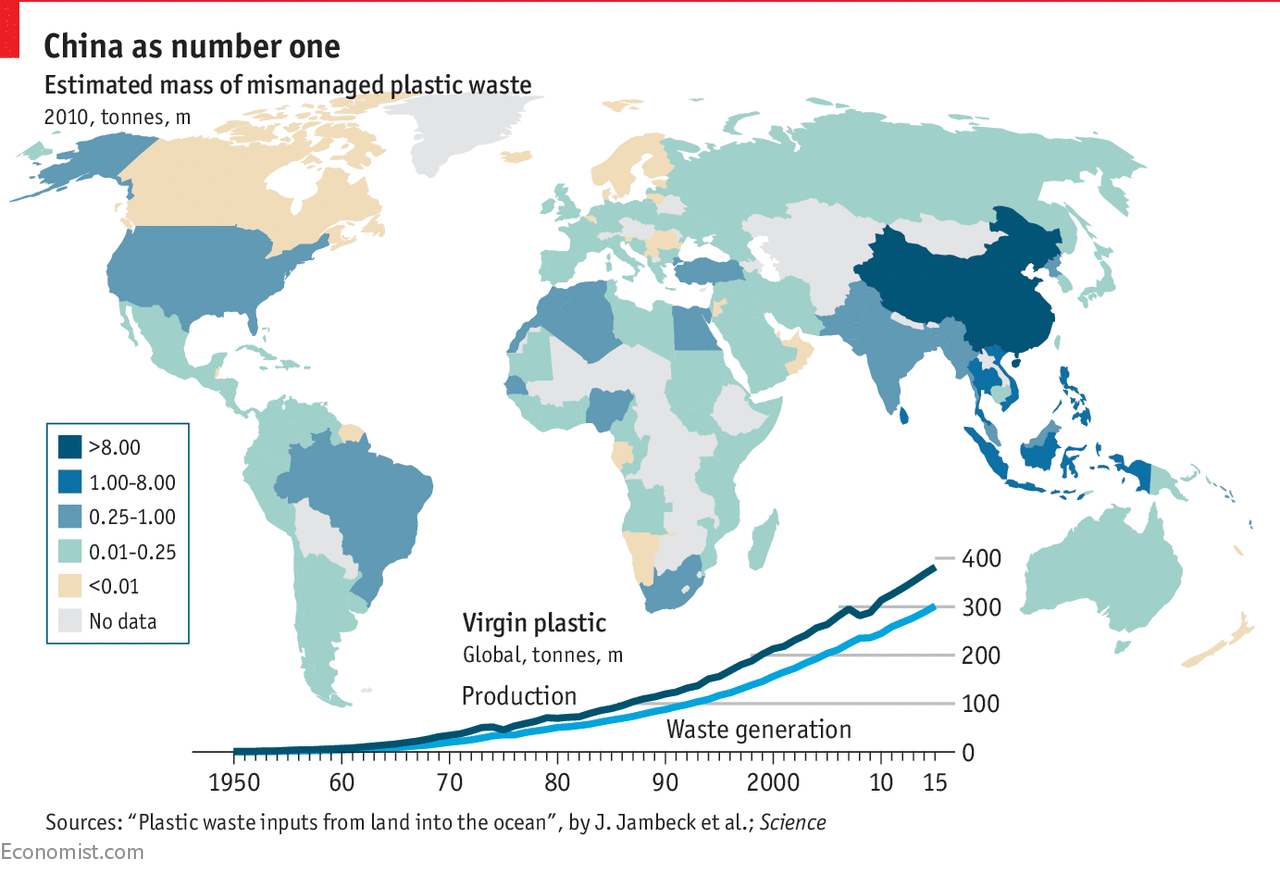
MR MCGUIRE had just one word for young Benjamin, in “The Graduate”: plastics. It was 1967, and chemical engineers had spent the previous decade devising cheap ways to splice different hydrocarbon molecules from petroleum into strands that could be moulded into anything from drinks bottles to Barbie dolls. Since then global plastic production has risen from around 2m tonnes a year to 380m tonnes, nearly three times faster than world GDP.

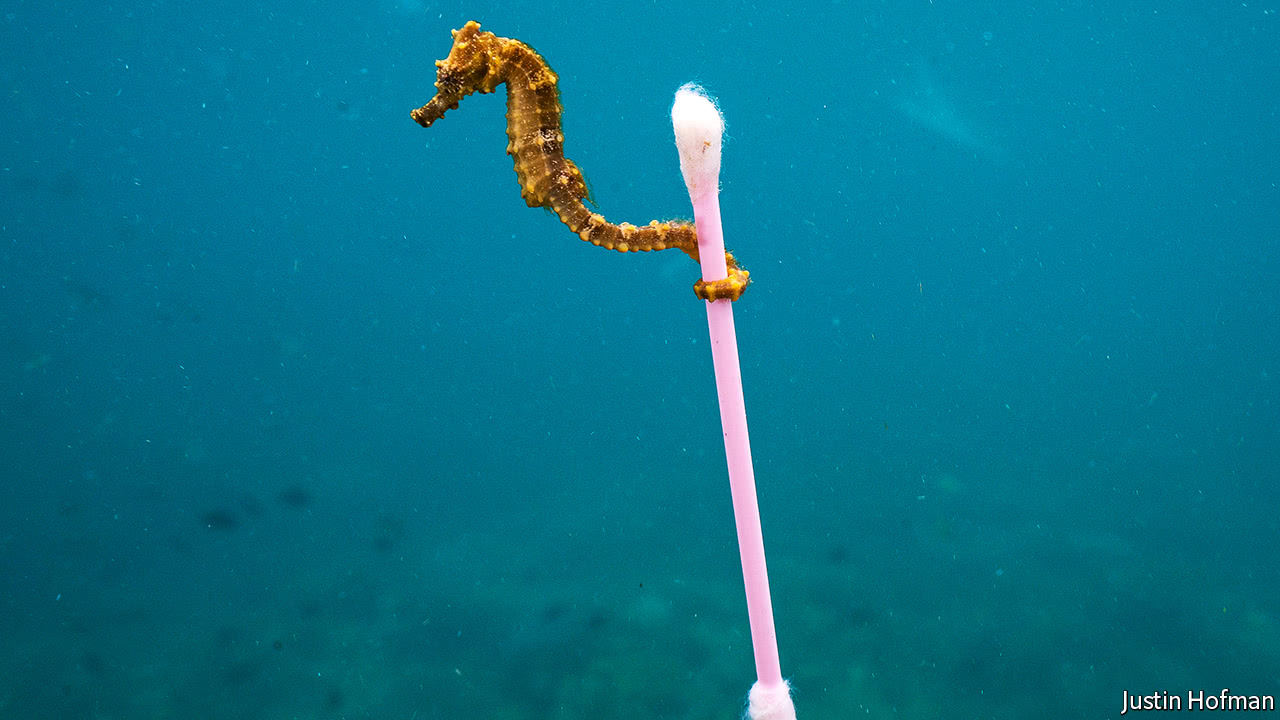
Unfortunately, of the 6.3bn tonnes of plastic waste produced since the 1950s only 9% has been recycled and another 12% incinerated. The rest has been dumped in landfills or the natural environment. Often, as with disposable coffee cups, drinks bottles, sweet wrappers and other packets that account for much of the plastic produced in Europe and America, this happens after a brief, one-off indulgence. If the stuff ends up in the sea, it can wash up on a distant beach or choke a seal. Exposed to salt water and ultraviolet light, it can fragment into “microplastics” small enoughto find their way into fish bellies. From there, it seems only a short journey to dinner plates.

Countries as varied as Bangladesh, France and Rwanda have duly banned plastic bags. Since last year anyone offering them in Kenya risks four years in prison or a fine of up to $40,000. In January China barred imports of plastic waste, while the European Union launched a “plastics strategy”, aiming, among other things, to make all plastic packaging recyclable by 2030 and raise the proportion that is recycled from 30% to 55% over the next seven years. A British levy on plastic shopping bags, introduced in 2015, helped cut use of them by 85%. On February 22nd Britain’s environment secretary, Michael Gove, mused about prohibiting plastic straws altogether.

Fearful for their reputations, big companies are shaping up. Coca-Cola has promised to collect and recycle the equivalent of all the drinks containers it shifts each year, including 110bn plastic bottles. Consumer-goods giants such as Unilever and Procter & Gamble vow to use more recycled plastics. McDonald’s plans to make all its packaging from recycled or renewable sources by 2025, up from half today, and wants every one of its restaurants to recycle straws, wrappers, cups and the like.
The perception of plastics as ugly, unnatural, inauthentic and disposable is not new. Even in “The Graduate” they symbolised America’s consumerism and moral emptiness. Visible plastic pollution is an old complaint, too (years ago, plastic bags caught in trees were nicknamed “witches’ knickers”). What is new is the suspicion that microplastics are causing widespread harm to humans and the environment in an invisible, insidious manner. “Blue Planet 2”, a nature series presented by Sir David Attenborough that aired in Britain last October and in America in January, made the case beautifully. But the truth is that little is known about the environmental consequences of plastic—and what is known doesn’t look hugely alarming.

A load of rubbish
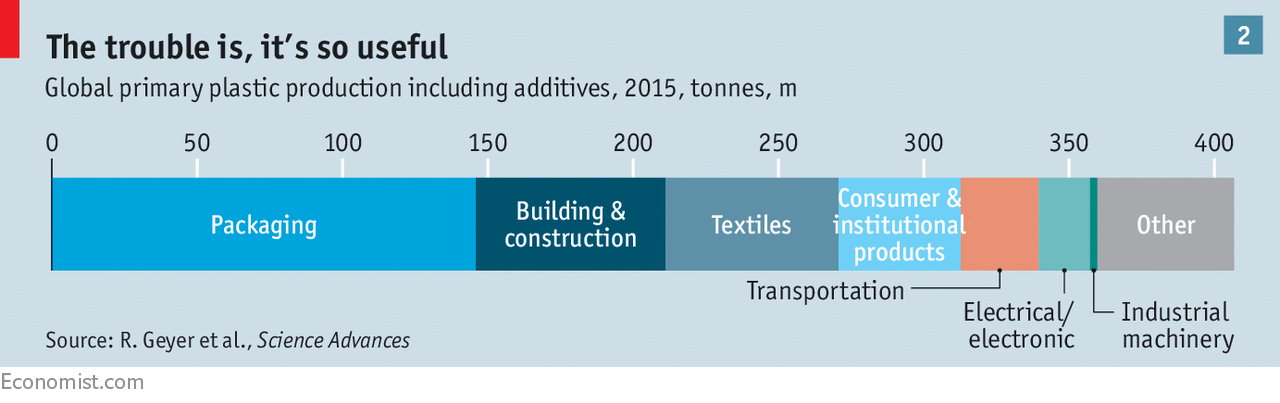
We can be surest about how much plastic is produced and where it ends up. In a paper published last year in Science Advances, Roland Geyer of the University of California, Santa Barbara, and his colleagues put the cumulative amount of solid plastic waste produced since the 1950s that has not been burned or recycled at 4.9bn tonnes (see chart 1). It could all have been dumped in a landfill 70 metres deep and 57 square kilometres in area—that is to say, the size of Manhattan.

If only it had all remained on land, or even washed up on beaches, where it could be collected. A bigger environmental worry is that much plastic has ended up in the ocean, where, dispersed by currents, the stuff becomes virtually irretrievable, especially once it has fragmented into microplastics. Computer models suggest that seas hold as many as 51trn microplastic particles. Some are the product of larger pieces breaking apart; others, like microbeads added to toothpaste or face scrubs, were designed to be tiny.

Whereas salt and sunlight can cause plastics physically to break apart into smaller pieces, chemically the hydrocarbons linked together into the polymer chains of which plastics are made do not spontaneously decompose into other compounds. Like crude oil, from which most polymers are derived, that happens only if they are burned at a high temperature to release mainly carbon dioxide and water. In normal conditions plastic simply accumulates in the environment, much as carbon dioxide does in the atmosphere.

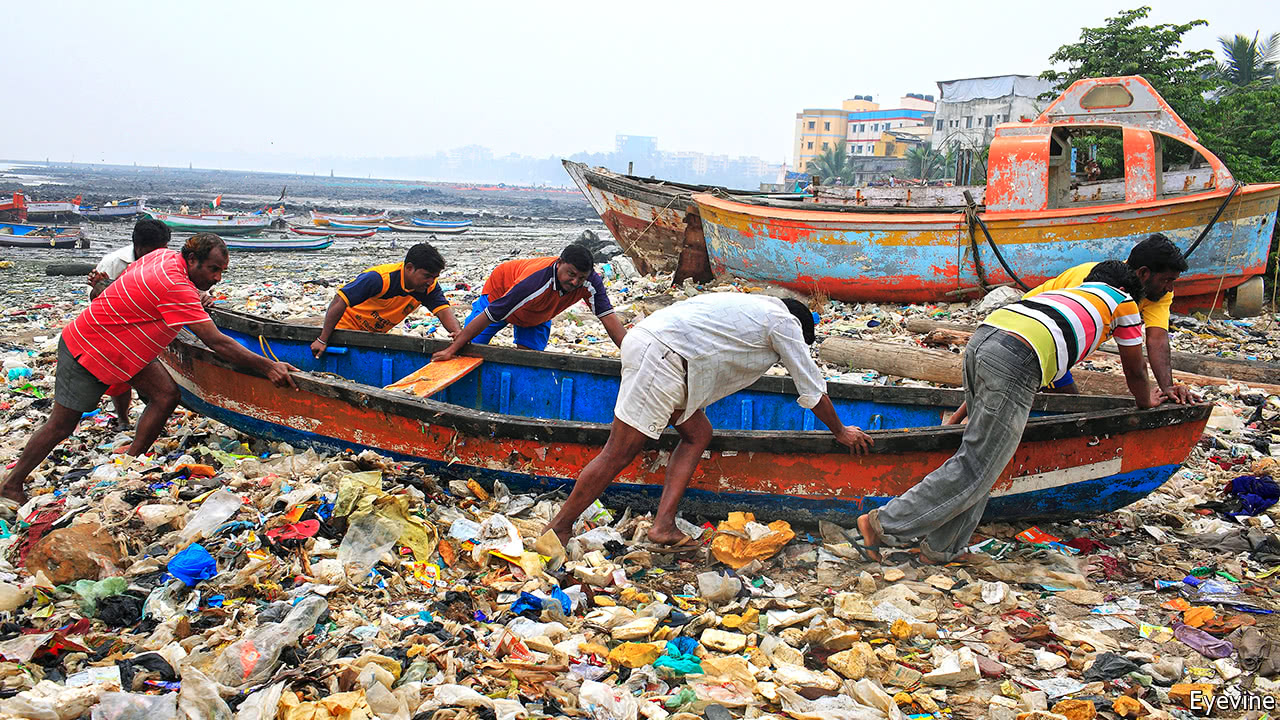
Even if the flow of plastic into the sea, totalling perhaps 10m tonnes a year, was instantly stanched, huge quantities would remain. And the flow will not stop. Most of the plastic in the ocean comes not from tidy Europe and America, but from countries in fast-developing East Asia, where waste-collection systems are flawed or non-existent (see map). Last October scientists at the Helmholtz Centre for Environmental Research, in Germany, found that ten rivers—two in Africa and the rest in Asia—discharge 90% of all plastic marine debris. The Yangtze alone carries 1.5m tonnes a year.
On current trends, by 2050 there could be more plastic in the world’s waters than fish, measured by weight. Such numbers frighten people and change their behaviour. Nine in ten Europeans worry about plastic’s impact on the environment. More than half told pollsters for Eurobarometer in 2017 that they try to forgo plastic bags when shopping. By comparison, only one-tenth consider fuel-efficiency when buying a new car. Unlike other kinds of pollution, plastic is an eyesore, notes Liz Goodwin of the World Resources Institute, a think-tank. Yet if a comprehensive league-table of environmental ills existed—which it does not—plastics would not top it.

Just 10% of 3.6m tonnes of solid waste discarded each day the world over is plastic. Whereas filthy air kills 7m people a year, nearly all of them in low- and middle-income countries, plastic pollution is not directly blamed for any. A report last year by the Lancet Commission on pollution and health, which put the total number of pollution-related deaths at 9m, mentions plastics once in its 45 pages.
On land, the damage from litter, which exercises many anti-plastic campaigners, is limited. Most refuse does not spread too far beyond population centres, where (at least in principle) it can be managed. At sea, most plastics end up in vast rubbish patches fed by ocean circulation patterns, the biggest of which can be found in the north Pacific.

Mid-ocean gyres are fortunately neither especially rich in fauna nor particularly biodiverse. The effects of plastics on busier bits of the ocean, such as reefs, have been little studied. One paper, published this year in Science by Joleah Lamb of Cornell University and colleagues, linked plastic litter to coral disease near Indonesia and Myanmar. But little similar work exists for other sedentary species, let alone slippery migratory ones.

Researchers have identified 400 species of animal whose members either ingested plastics or got entangled in it. It is known that because polymers repel water (which is why droplets form on their surface), plastic particles also attract certain compounds from their surroundings. Some of these could be toxic. Laboratory studies have shown that if swallowed by fish, compounds in plastic fragments can be absorbed from the digestive tract into flesh. However, no studies have so far been performed to test whether such toxins concentrate up the food chain, as mercury does in fish. The only direct evidence of plastic entering the human diet is a study by Belgian scientists who discovered plastic fragments in mussels. Unlike fish, bivalves are eaten whole, guts and all.

Munching moules-frites seasoned with a pinch of plastic may sound unappetising but it is hard to say if it is dangerous, says Stephanie Wright, who studies the subject at King’s College, London. Polymers are chemically inert, and so do not themselves present a health risk. Some common additives such as phthalates (which soften PVC) or bisphenol-A (which hardens many types of plastic used in consumer goods) are chemically akin to human hormones, and might therefore disrupt them in high concentrations. For decades both have been licensed for use in everything from pipes to shampoo bottles because human exposure was unlikely to exceed safe limits. America now bans some phthalates in toys and child-care products because of potential harm to growing children.

Weighing the damage

Trucost, a research arm of Standard & Poor’s, a financial-information provider, has estimated that marine litter costs $13bn a year, mainly through its adverse effect on fisheries, tourism and biodiversity. It puts the overall social and environmental cost of plastic pollution at $139bn a year. Of that half arises from the climate effects of greenhouse-gas emissions linked to producing and transporting plastic. Another third comes from the impact of associated air, water and land pollution on health, crops and the environment, plus the cost of waste disposal.

To put that into perspective, the United Nations Development Programme says that the costs of overfishing and fertiliser run-off amount to some $50bn and $200bn-800bn a year, respectively. By 2100 ocean acidification, which is caused by atmospheric carbon dioxide dissolving into water, could cost $1.2trn a year. The costs of rapid ocean warming caused by human-induced climate change are hard to fathom but are likely to be enormous.

The overall cost of plastic pollution compares favourably with other sorts of man-made harm mostly because plastics are light. Making a kilogram of virgin plastic releases 2-3kg of carbon dioxide, about as much as the same amount of steel and five times more than wood. But a product made of plastic can weigh a fraction of a comparable one made of other materials.

That is why replacing plastic with other things could raise environmental costs at least fourfold, according to Trucost’s analysts. This is even true of the various virtue-signalling alternatives to plastic bags. A British government analysis from 2011 calculated that a cotton tote bag must be used 131 times before greenhouse-gas emissions from making and transporting it improve on disposable plastic bags. The figure rises to 173 times if 40% of the plastic bags are reused as bin liners, reflecting the proportion in Britain that are so repurposed. The carbon footprint of a paper bag that is not recycled is four times that of a plastic bag.
And other materials could not replace plastics in all circumstances. Imagine a hospital without surgical gloves, or promiscuity without condoms. By keeping food fresh for longer, plastic packaging substantially reduces organic waste, itself a growing environmental concern. In 2015 J. Sainsbury, a British grocer, reduced waste in a beefsteak line by more than half by using plastic vacuum packaging.

Plastic pollution “is not the Earth’s most pressing problem”, in the words of one European official. But, he immediately adds, just because plastics may not be the biggest problem facing humanity does not make them trouble-free. As scientists never tire of repeating, more research is needed. It is the absence of evidence about how plastics influence health rather than evidence of absence that explains their bit part in the Lancet Commission report, says Philip Landrigan of the Icahn School of Medicine in New York, who chaired it.

Fresh science may be forthcoming. In the past two years Ms Wright has noticed an uptick in grants for plastics-related research. Erik van Sebille, of Utrecht University in the Netherlands, recalls that a few years ago a seminar on ocean plastic pollution organised by America’s National Oceanic and Atmospheric Administration drew perhaps 200 participants. This year organisers had to cap attendance at 600 and turn people away.

While researchers get a better handle on the science, campaigners badger politicians and browbeat consumers to kick the polymer habit. They often invoke the precautionary principle. If the impact of something is uncertain but could be great, the argument goes, better forestall it just in case. As the proliferation of plastic bans and strategies suggest, they are having some success.

PET peeves

Much of this activity makes scarcely a dent in the world’s plastic pollution problem, however. Some has unintended consequences. Making plastics biodegradable, by adding corn starch or vegetable oil to petroleum-derived hydrocarbons, renders them harder to recycle. Recyclers already struggle to invest in capacity or innovation even in countries that collect lots of their rubbish. Periodic declines in the oil price, which makes virgin plastic cheaper, can bankrupt recyclers, many of which are small or medium-sized companies, says Peter Borkey of the OECD, a rich-country think-tank.

Meanwhile consumer-goods firms sometimes say that too little recycled plastic is available to buy. With costs of some recycled plastic competitive with virgin stuff, “supply is a bigger issue than cost,” says Virginie Helias, Procter & Gamble’s vice-president for sustainability. In other words, erratic demand appears to dampen supply while insufficient supply inhibits demand. Recyclers everywhere face that problem. There is no guarantee that targets like the EU’s will solve it.

China’s import ban may provide the necessary jolt. Introduced as part of a broader clampdown on pollution, it took waste exporters by surprise. In 2017 European countries shipped a sixth of their plastic waste for disposal abroad. Most sailed to China. In the short run some surplus waste can go to Malaysia or India, but those countries’ capacity is a fraction of China’s. Eventually, refuse exporters will have to deal with more of it at home.

Building recycling capacity is one option. Incineration is falling out of favour for heating or electricity generation as coal-fired plants are replaced with gas, which emits less greenhouse gases than waste-to-energy plants. From an ecological standpoint, landfilling is not as bad as it looks, so long as additives that might leach out of the polymers are prevented from escaping. Plasma recycling, where refuse is heated to as much as 5,000°C, turning it into unadulterated hydrocarbons plus a solid residue, looks promising but remains some way from commercialisation.
To be disposed of, though, plastic waste must be collected. In Europe, America and other developed places, virtually all of it is. To eliminate marine litter in particular, more rubbish needs to be picked in the leaky Asian countries.

China’s anti-pollution drive may bring about improvements, although the country now pays more attention to filthy air and water, which are more pressing concerns. Indonesia has launched its own National Action Plan on marine plastic. The other big polluters are eyeing similar measures. What happens there over the next few decades will matter more than any number of Western plastic-bag bans.

Wednesday, February 07, 2018

Political Correctness - The tyranny of “PC culture” is real   and a threat to liberal society

Political Correctness

The tyranny of “PC culture” is real — and a threat to liberal society

Shortly after the London Bridge terror attacks on June 3, prominent left-wing pundit Sally Kohn used the occasion to tweet a defense of political correctness:
Yet only a few days earlier, there had been a flurry of reports on a very different kind of political correctness. Bret Weinstein, a biology professor at Evergreen State College in Olympia, Washington, had been subjected to vicious harassment for objecting to a Day of Absence, in which white people were asked to stay off campus for a day. Amid calls for his firing, Weinstein was surrounded and berated by student protesters and finally informed by the police that it was not safe for him to be on campus. There was very little dignity or respect in the way he and his supporters were treated.
So which is the real political correctness?
Kohn’s defense is certainly not new or unique. A couple of years ago, New Zealand programmer Byron Clark made the same point with a Google Chrome that converted the phrase “political correctness” to “treating people with respect.”
The progressive media loved it. Vox’s Amanda Taub, one of a number of left-of-center pundits who have dismissed political correctness as a made-up problem, asserted that Clark’s “simple experiment” shows “what’s really going on when people complain about PC culture”: It’s just “a cold dismissal of people’s requests to be treated with respect.”
Granted, when you try this trick (as Taub did) on Donald Trump’s statement that he doesn’t have time for political correctness, the result is not only hilarious but also on-target. But mostly, the experiment falls flat unless you’re already convinced. Indeed, a look at the articles whose headlines Clark used for his demo shows that the translation is ridiculously off the mark.
For instance, “The Real Danger of Political Correctness” (Washington Post) was penned not by some white male reactionary but by a progressive feminist, culture critic Alyssa Rosenberg, who argued that attempts to create “bias-free language” — such as “person of size” instead of “obese” — not only leads to “impoverished and clunky” newspeak but also encourages avoidance rather than examination of difficult issues.
“Political Correctness Is Fuelling Homegrown Extremism, Claims Proud British Muslim” (London Daily Express) quoted practicing Muslim Haseeb Ahmed as saying that fear of causing offense made it difficult to talk honestly about Islamist fanaticism and terror groups such as ISIS, the Islamic State. It’s rather ironic that in his defense of political correctness, Clark, a white man, was appropriating, altering, and mocking the words of a woman and a brown Muslim man. You might even say it’s not very PC.
To be sure, the term “politically correct” gets misused. Sometimes, the online hooligans of the alt-right — and their more sophisticated enablers such as disgraced far-right cult figure Milo Yiannopoulos — use it to dismiss any objections to real and overt racism, misogyny, and other bigotries. Sometimes, internet grouches fling the “PC” slur at movies or TV shows that are seen as having too much girl power or minority presence.
But for the most part, when people talk about “political correctness gone amok,” that’s not what they mean. “PC” generally refers to over-the-top outrage at things no one but a hypersensitive fringe actually finds disrespectful, or rigid taboos on opinions and facts that could be construed as offensive, or extreme and punitive intolerance toward any deviation from the one true faith (just ask Professor Weinstein, a progressive victimized by his own).
Here are just a few episodes — some famous, some obscure — from the recent history of political correctness.
  • In October 2015, Yale’s Intercultural Affairs Council sent out a campus-wide email warning against costumes that could cause offense, especially ones that could be seen as stereotyping or making light of a culture. Lecturer Erika Christakis, associate master of the school’s Silliman Residential College, countered with an email to the undergraduates at Silliman defending young people’s right to make their own choices and push boundaries. (Her message was inspired by conversations with students annoyed by the IAC directive.) Outrage ensued. Christakis was pilloried in an open letter signed by hundreds of Yale students, faculty, and staff; her husband, Silliman College master Nicholas Christakis, was mobbed and berated by students in a notorious incident captured on video. Later, protesters demanded that both Christakises be removed from their Silliman posts. While the school did not act against the embattled couple, it did not defend them, either; university president Peter Solovey and Yale College dean Jonathan Holloway issued statements supporting and embracing the protesters. Erika Christakis stopped teaching at Yale shortly after the incident; several months later, in May 2016, she and her husband stepped down from their positions at Silliman College.
  • Another outrage cycle in October 2015 targeted a promotional photoshoot for Suffragette, the film about the fight for the women’s vote in England. Meryl Streep, who starred as suffragist leader Emmeline Pankhurst, and three other actresses were shown wearing a T-shirt with a quote from Pankhurst: “I’d rather be a rebel than a slave.” The slogan was decried as “tone-deaf,” supposedly trivializing the black experience of slavery and allowing white women to claim it as their own. Some saw an additional offense in the juxtaposition of “rebel” and “slave,” asserting that in the context of American history it sounded like an obvious reference to the Confederacy. The critics had to admit that the original passage from Pankhurst’s speech did not refer to the Confederacy or to black slavery, using the term “slave” in a metaphorical sense — but they argued that since some people saw offensive connotations in the quote, the quote was offensive.
  • In October 2014, the British National Student Union rejected a motion condemning ISIS, the Islamist terror group infamous for its horrific atrocities, on the grounds that the resolution could promote Islamophobia. A year later, in December 2015, the same rationale was used at the University of Minnesota in the U.S. to kill a proposal for a minute of silence to honor the victims of the September 11, 2001, terror attacks.
  • Charges of cultural appropriation have been hurled at everything from yoga classes (banned at the University of Ottawa in 2015) to dreadlocks on white people to a kimono exhibit at the Boston Museum of Fine Arts to ethnic food. In May, a recently launched burrito shop in Portland shut down after its white female owners’ account of collecting recipes on a vacation in Mexico got them denounced for “stealing” and “culinary white supremacy” in the local left-wing press and the digital media. Around the same time in Canada, author Hal Niedzviecki had to resign as editor of Write, the magazine of the Writers’ Union of Canada, due to the backlash against his opinion column arguing that writers should be applauded, not condemned, for appropriating other cultures and experiences. The Writers’ Union of Canada apologized and pledged to review its editorial policies, presumably to make sure no such lapse into heresy would happen again.
  • Various colleges have instituted procedures for policing the most trivial of perceived bias incidents—such as a professor merely mentioning the belief that transgender identities are “not real” or female students having a “slut-shamey” conversation about a fellow student described as a “bro-hopper.” Educational posters put up on campuses have featured “crazy,” “you guys,” “illegal alien,” and “did you lose weight?” as examples of offensive language. At the University of California, microaggressions include asking an immigrant where s/he is from, encouraging a quiet Asian American or Latino to speak up, or expressing the opinion that women in America today have the same opportunities as men.
  • Abortion rights advocacy organizations have been under intense pressure, mostly from younger activists, to avoid gender-specific language (such as “women”) so as to be inclusive to female-bodied individuals who may get pregnant and seek abortions but identify as male or nonbinary. An abortion rights fundraising event humorously dubbed “Night of a Thousand Vaginas” was met with anger from offended activists who thought it excluded transgender women.
All these stories — and there are many, many more — add up to enough of a pattern to suggest some conclusions.
1. Yes, there definitely is such a thing as political correctness or PC culture, built around identity politics and intersectionality — an ideology that views life in modern liberal societies as shaped entirely by an entrenched system of intersecting oppressions and sees all human interaction in terms of oppression and privilege.
Because this ideology is intensely focused on changing attitudes and eliminating subtle, deeply embedded biases, speech- and thought-policing are not just unfortunate excesses of zeal but an essential part of the “social justice” project.
2. While critics of the concept of political correctness often assert that PC doesn’t limit freedom of speech but merely exposes the privileged to criticism from the marginalized, many PC incidents are likely to have a very real chilling effect on speech and expression.
The privileged transgressors often suffer serious career damage, not only in the academy but also in the left-of-center media and the arts and culture scene. The Christakises and Niedzviecki are far from the only casualties:
  • In the fall of 2015, Mary Spellman, dean of students at Claremont McKenna College in California, was hounded out of her job by protesters because of an email deemed to be racially insensitive. Spellman’s offense: While offering to help a minority student who was having a hard time at school, the dean had written that she wanted to “better serve students, especially those who don’t fit our CMC mold” — a statement some took to imply that people of color don’t belong at the college.
  • In 2013, science fiction and fantasy author Jean Rabe had to resign as editor of the SFWA Bulletin, the bimonthly magazine of the Science Fiction and Fantasy Writers of America, due to accusations of sexism — despite being a woman. Rabe’s offenses included a magazine cover with a bikini-clad woman warrior (in tribute to classic sci-fi) and a feature in which two male contributors discussed notable female authors and editors in the history of sci-fi and made too many references to some of the women’s looks.
PC also threatens free debate and exchange of ideas by defining heretical opinions as harmful and violent. The effects are particularly baneful when it comes to discussion of contentious issues related to race, gender, and sexual identity. One recent example is the hounding of Rebecca Tuvel, an assistant professor of philosophy at Rhodes College in Memphis, Tennessee, who wrote an article examining parallels between transgender identities and transracialism — the adoption of a different racial identity.
Tuvel, who fully supports transgender rights, was accused of “enact[ing] violence” and causing “harm” by, among other things, using the term “transgenderism,” referring to “male genitalia” and “biological sex,” and mentioning Caitlyn Jenner’s pretransition name, Bruce. The editors of Hypatia, the feminist philosophy journal that had published the essay, issued an apology and stated that “a more effective review process” would have prevented the “harms” its publication had done. Feminist philosopher Kelly Oliver wrote that a number of academics supported and sympathized with Tuvel in private messages while either remaining silent or actually denouncing her in public.
On at least some occasions, the effort to silence politically incorrect speech has turned violent. Last March, conservative scholar Charles Murray, who has been accused of racism for writing about racial differences in IQ, was not only prevented from giving a scheduled talk (on the cultural gap between the white elites and the white working class) at Vermont’s Middlebury College by protesters who would not stop shouting and chanting, he was also literally chased by a violent mob when he left the building. Alison Stanger, the Middlebury professor who interviewed Murray on a livestream held in lieu of the lecture, received a neck injury in the melee.
3. The “crimes” targeted by the PC police are not about deliberate or even subconscious bigotry but about violations of ideological taboos (such as cultural appropriation) and/or far-fetched, paranoid interpretations of innocent words and actions (such as the Confederacy allusion in the slogan “I’d rather be a rebel than a slave”).
Since one of the tenets of PC orthodoxy is that questioning the validity of grievances expressed by the marginalized is itself a harmful microaggression, the accusations come with a built-in presumption of guilt. It doesn’t matter if most members of the same disadvantaged group see no offense.
What’s more, PC has nothing to do with actual social justice: Stopping white people from wearing dreadlocks will not, in any appreciable way, help with the real problems facing the black community, just as banishing the word “crazy” will do nothing to improve the situation of the mentally ill.
In some cases, intersectional PC actively prevents confronting oppression. For instance, since Muslims are defined as marginalized, feminists who speak out against the misogyny of Islamic fundamentalism can be accused of promoting Islamophobia. This leads to such surreal moments as the 2015 controversy over a talk by Iranian-born feminist and ex-Muslim Maryam Namazie at the University of London’s Goldsmith College, where feminist and LGBT groups joined the campus Islamic Society in denouncing the event as a “safe space” violation.
Some critics of the anti-PC backlash assert that there is also a political correctness on the right.
Indeed, Quartz contributor Noah Berlatsky has argued that the right-wing version of PC tends to manifest itself in far more aggressive forms of speech suppression than that of the left. But this claim rests on an absurdly broad definition of PC that includes any attack or intimidation based on political hostility. Berlatsky cites online harassment of feminists and a threat of violence that resulted in the cancellation of a lecture by feminist video game critic Anita Sarkeesian — actions that he acknowledges have been widely condemned, though not characterized as PC — as well as personal attacks by the right-wing website Breitbart.com on social justice activists.
But internet harassment, threats, and personal attacks on opponents exist across the political spectrum (the first two often perpetrated by trolls with no ideological allegiances). They don’t have the institutional backing, the moralism, or the groupthink of PC culture.
Of course, the right has also used social pressure to shut down what it considers to be offensive speech.
In 1998, boycotts helped kill the ABC series Nothing Sacred, regarded as anti-Catholic by some conservatives for its portrayal of a priest who struggled with his faith and questioned Church teachings on sexuality. In the 2000s, critics of the war in Iraq often encountered a nasty backlash that amounted to punishing or muzzling them. The Dixie Chicks, the popular country music band, were targeted in 2003 after lead singer Natalie Maines told a London audience that they were anti-war and were “ashamed” to be from the same state as President Bush; despite the singers’ apologies, they faced a ruinous boycott, and some DJs lost their jobs for playing Dixie Chicks songs. The same year, reporter Chris Hedges, who criticized the war in a commencement speech at Rockford College in Illinois, was shouted down by hecklers who also unplugged his microphone and at one point rushed the stage. Some conservative pundits defended this as nothing more than robust protest. There’s plenty of all-around hypocrisy on free speech.
But there are differences.
What left-wing journalist John K. Wilson calls “patriotic correctness” lasted a short time at the height of pro-war fervor and targeted fairly narrow categories of speech; even the Dixie Chicks backlash was related to the view that a wartime president should not be denounced abroad. (Other outspoken anti-war celebrities, such as actors Samuel L. Jackson and Uma Thurman, emerged unscathed.)
Political correctness casts a much broader net and demands far more zealous compliance — all the more so since the rules are subjective and constantly shifting, so you can never be sure whether you are in compliance or not until you get called out. Not even the worst watchdogs of patriotic correctness have ever hounded anyone over a comment judged to have unintended unpatriotic connotations.
What’s more, much like religious cults and totalitarian regimes, PC culture not only prohibits heresy but also requires active declarations of orthodoxy. In May, pop singer Demi Lovato was featured in a new music video sporting a hairstyle that, from a distance, looked like dreadlocks. After being called out for cultural appropriation on Twitter, Lovato tweeted to explain that her hair was actually styled in tiny twists:
Mic, the self-appointed digital Pravda of PC, declared that the singer had “messed up a little.” Many offended people, you see, “wanted Lovato to not just publicly deny that they were dreads, but also let her fans know that she understands why that would be so hurtful.” Yet, even when pressed, the stubborn pop star refused to admit that those fans “had every right to feel uncomfortable with the idea that Lovato would wear a hairstyle that strongly resembles locs in the first place.”
The Mic article bore the censorious title, “After Being Called Out for Wearing Faux Dreadlocks, Demi Lovato Still Doesn’t Get It.” To which one could respond, “After being repeatedly told that people are sick of PC, Mic still doesn’t get it.”
In the past several years, political correctness has dominated not only the academy but much of the left-of-center press and digital culture as well. It has a strong presence in art and entertainment and is practically the official religion in “geek culture” communities.
The consequences are dangerous in more than one way.
First of all, political correctness by itself is destructive to the liberal project — to reasoned discourse, free exchange of ideas, culture and community. What makes it uniquely injurious is its rising dominance in spheres of society traditionally associated with intellectual openness and pluralism: the academy, quality journalism, literature, and the arts. Until recently, these were the standard-bearers of the Enlightenment ethos, which challenged any attempt to circumscribe the pursuit of truth and freedom of thought and expression — whether by religion, government, traditional social norms, or other forces. PC may not be a novel form of power dynamics, but it is one especially corrosive to a classically liberal system.
Secondly, PC culture also invites an equally or more toxic backlash, led by the likes of Yiannopoulos. The worst of anti-PC culture is exemplified by the racist, anti-Semitic, and misogynistic troops of the alt-right. Of course modern-day “social justice warriors” did not create racism, misogyny, and other bigotries that predate their existence. But too many people fed up with identity politics, gratuitous white- and male-bashing, and overzealous thought- and speech-policing end up being drawn into the web of the alt-right.
Political correctness enables bigotry both by trivializing it — if you can be called a racist for wearing a sombrero on Halloween or a misogynist for admiring sexy women, the words lose much of their bite — and by green-lighting it when it’s directed at “privileged” groups. When comments like “yet another opinion from an old white man” become weapons of choice in what passes for debate in PC culture, the principle that people should not be attacked or demeaned on the basis of race, gender, or other aspects of who they are becomes increasingly difficult to defend.
Donald Trump’s election victory, itself almost certainly aided by the anti-PC backlash, has made it clear that we need to heal our dysfunctional political culture. One necessary step toward such healing is to restore the classical liberal norms of free thought and free speech. That does not preclude rejecting real bigotry and hate, but respect does not require political correctness. In fact, political correctness is the opposite of respect.

Cathy Young

Medium member since Mar 2017
Russian-Jewish-American writer. Pro-individual freedom, pro-gender equality, pro-dialogue. Reason, Newsday, The Forward etc. https://www.patreon.com/CathyYoung

Thursday, January 18, 2018

Doubling global atmospheric CO2 won't raise the planet's temperature as much as originally believed.

Climate sensitivity study suggests narrower range of potential outcomes

Findings should not be seen as taking pressure off need to tackle climate change, authors warn

Earth’s surface will almost certainly not warm up four or five degrees Celsius by 2100, according to a study which, if correct, voids worst-case UN climate change predictions.

A revised calculation of how greenhouse gases drive up the planet’s temperature reduces the range of possible end-of-century outcomes by more than half, researchers said in the report, published in the journal Nature.

“Our study all but rules out very low and very high climate sensitivities,” said lead author Peter Cox, a professor at the University of Exeter.

How effectively the world slashes CO2 and methane emissions, improves energy efficiency and develops technologies to remove CO2 from the air will determine whether climate change remains manageable or unleashes a maelstrom of human misery.

But uncertainty about how hot things will get also stems from the inability of scientists to nail down a very simple question: By how much will Earth’s average surface temperature go up if the amount of CO2 in the atmosphere is doubled?

That “known unknown” is called equilibrium climate sensitivity, and for the last 25 years the UN’s Intergovernmental Panel on Climate Change – the ultimate authority on climate science – has settled on a range of 1.5C to 4.5C (2.7 to 8.1 degrees Fahrenheit).

Cox and colleagues, using a new methodology, have come up with a far narrower range: 2.2C to 3.4C, with a best estimate of 2.8C.

If accurate, it precludes the most destructive doomsday scenarios. “These scientists have produced a more accurate estimate of how the planet will respond to increasing CO2 levels,” said Piers Forster, director of the Priestley International Centre for Climate at the University of Leeds.

Gabi Hegerl, a climate scientist at the University of Edinburgh who, like Forster, did not take part in the research, added: “Having lower probability for very high sensitivity is reassuring. Very high sensitivity would have made it extremely hard to limit climate change according to the Paris targets.”
The landmark Paris climate agreement in 2015 called for capping global warming at “well under” 2C compared to a pre-industrial benchmark, and pursuing efforts for a 1.5C ceiling.

The findings should not be seen as taking pressure off the need to tackle climate change, the authors and other experts warned. “We will still see significant warming and impacts this century if we don’t increase our ambition to reduce CO2 emissions,” said Forster.

Even a 1.5C increase will have consequences. With a single degree Celsius of warming so far, the Earth is already coping with a crescendo of climate impacts including deadly droughts, erratic rainfall, and storm surges engorged by rising seas.

A 3.5 C world, scientists say, could pull at the fabric of civilisation.

Since industrialisation took off in the early 19th century, CO2 concentrations in the atmosphere have increased by nearly half, from 280 parts per million to 407 parts per million.

Up to now global warming predictions have focused on the historical temperature record.
Cox and colleagues instead “considered the year-to-year fluctuations in global temperature,” said Richard Allan, a climate scientist at the University of Reading.

By analysing the responsiveness of short-term changes in temperature to “nudges and bumps” in the climate system, he explained, they were able to exclude the outcomes that would have resulted in devastating increases of 4C or more by 2100.

One wild card not taken into consideration by the new model is the possibility of rapid shifts in climate brought on by the planet itself. “There is indeed evidence that the climate system can undergo abrupt changes or ‘tipping points’,” Cox said.

The collapse of the gulf stream, the thawing of carbon-rich permafrost, or the melting of ice sheets on Greenland and Antarctica – any of these could quickly change the equation, and not in the Earth’s favour.

 Source: https://www.theguardian.com/science/2018/jan/18/worst-case-global-warming-scenarios-not-credible-says-study?utm_source=esp&utm_medium=Email&utm_campaign=GU+Today+main+NEW+H+categories&utm_term=260850&subid=24733161&CMP=EMCNEWEML6619I2

Monday, January 08, 2018

Australia's Great Barrier Reef is still Great, but the research isn't.

Our Reef is still Great, but the research isn't

By Graham Young - posted Monday, 8 January 2018


For 50 years I've been worrying about the fate of the Great Barrier Reef. First it was mining and drilling, then the Crown of Thorns Starfish, agricultural run-off, coral bleaching, dredging and lately ocean acidification and Adani.

This week an infestation of starfish on Swain Reefs heralds the return of more "reef in crisis" stories, as predictable as summer thunderstorms.

As time has progressed I've become less sensitive to each new claim because the reef is manifestly, and gloriously, still there.

A new paper by Dr Piers Larcombe and Professor Peter Ridd, published in the Marine Pollution Journal this month, suggests that perhaps not only is there no need to worry, but that much of the science underpinning what we think we know about the GBR is wrong. And not only the GBR. In 2005 John Ioannidis wrote a paper titled "Why Most Published Research Findings are False". Since then there has been a flood of papers demonstrating that 50% or more of research papers are wrong in most scientific fields.

According to the editor of the world's second most influential medical journal The Lancet this is because of "small sample sizes, tiny effects, invalid exploratory analyses, and flagrant conflicts of interest, together with an obsession for pursuing fashionable trends of dubious importance…"
Science relies on peer review as a form of quality control, but to anyone who has been involved in this process it has problems.

This is because peer review can be "biased, unjust, unaccountable, incomplete, easily fixed, often insulting, usually ignorant, occasionally foolish, and frequently wrong," again according to the Lancet editor.

In the commercial field this doesn't matter so much. No one is going to spend $2.5B (the average in 2014) developing a new prescription drug based on science that hasn't been put to the test.
Companies do their own due-diligence ensuring studies have been properly set-up, results are significant and can be replicated.

In some areas governments spend money ensuring that science is rigorous. How many billions were spent searching for gravity waves, quality assuring Einstein's theory of relativity? But in relation to what Larcombe and Ridd call "policy-science", there is no process for quality control and assurance.
And this is a huge problem.

The Great Barrier Reef stretches over 2,300 kilometres of coastline. It is exploited by fishermen and tourism operators, and potentially affected by coastal and hinterland development anywhere from Bundaberg to the tip of Cape York.

It is valuable in and of itself, and it has value to the people who make a living from it. Protecting one value can impact on the other, and the cost will be variously shared by all taxpayers as well as specific communities.

Ridd and Larcombe find that 9 of the most heavily cited (5,791 times) studies on the GBR are flawed.
Yet on the basis of them government has committed to spend $1B, and is being asked to commit another $8B, plus inflicting unquantified financial and emotional costs on communities and businesses.

They call on the government to establish an "Institute for Policy-Science Quality Control" to first examine existing studies, and audit future studies.

Will this achieve their aim? Even if it is an independent body, it will still be subject at some level to government oversight and control, and that introduces politics.

An alternative not in their paper is the idea of "red" and "blue" teams, a strategy imported from the military into commerce. Military commanders in the US realised that plans were failing due to group think and confirmation bias. They came up with the idea of setting-up a "red team" which would try to pick holes in the "blue team" strategies.The US EPA Administrator is considering using this technique with respect to climate science. But none of these, or related concepts, are likely to work unless we find ways to institutionalise dissent in our universities and scientific organisations.

For an early- to mid-career researcher, disagreeing with a powerful established academic can end a career. Even for a tenured professor like Ridd it is a risk. James Cook University is taking action against him for "misconduct" because of his criticism of the quality of GBR research.

Quality control in science is an institutional problem we desperately need to solve.

The scandal is we know it exists, have done nothing about it, and have spent billions of taxpayer dollars, in ignorance, or deliberately not caring.

That has to stop. We face too many real problems to waste time solving imaginary ones.